

It’s getting to that time of the year again where everyone gets extremely busy especially leading up to the end of the financial year!
May & June appointments are filling fast so give the team at Dental at Keys a call to book your appointment in. You definitely don’t want a toothache or a broken tooth over the holidays!
If you have health insurance (that resets every financial year) – consider making full use of your health insurance and Maximise your rebate for this year.
You pay high premiums to have extras so don’t lose your chance to use it in 2019!
Some health insurances will reset your limits on the 1st of July every year so any funds you have available for dental work will be lost if not used by June 31st.
Exciting news everyone!
We’ve just updated our payment plan page here.
Take a look and let us know what you think.
Just remember, we are here to help!
So, you’ve received a preventative maintenance postcard and you are wondering what the answers were?
For postcards – part three:
Did you get them all correct?

So, you’ve received a preventative maintenance postcard and you are wondering what the answers were?
For postcards – part two:
Did you get them all correct?

So, you’ve received a preventative maintenance postcard and you are wondering what the answers were?
For postcards – part one:
Did you get them all correct?

So you’ve taken your child to the dentist and the dentist has recommended fissure sealants. What are sealants and why do they need them?
Dental fissure sealants are a protective layer applied to the fissures in your teeth to prevent tooth decay.
All teeth come in varying shapes and sizes. At times, the adult tooth can form with a lot of grooves and ditches. When a new adult tooth erupts, the tooth is at a higher risk of decay.
This is because:
Due to these varying factors, fissure sealants can be a good way to seal the top of the tooth and reduce the amount of plaque accumulating on it. This makes the tooth easier to clean.
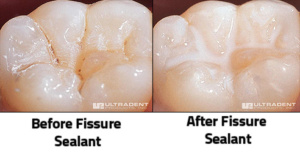
HOW?
For a sealant to be effective, the area needs to be very dry so it will depend on how your child does in the chair as well.
Fissure sealants are not designed to be a permanent. It usually comes off a few years after, when the child is older and more able to clean the tooth well. They can come off sooner depending on their diet. We recommend not to eat chewy or sticky lollies (e.g. Minties, Fantales) because these can pull off the sealants.
So if you’ve got any questions or unsure if you child needs sealants- give us a call or make an appointment online! Contact us now!
The root cause of sensitive teeth is when there is enamel wear which then exposes the inside layer of the tooth called ‘dentine’. The enamel is like a shield and the ‘dentine’ makes up the majority of the tooth on the inside. Dentine can feel cold sensitivity quite sharply.
First of all, see your dentist. You need to find out the cause of your sensitivity and then figure out ways to deal with it.
Come see us and let us help with your sensitivity so you can eat an ice-cream* drink a nice cold glass of water with no fear!
*Ice-cream is bad for your teeth but delicious so we’ll allow it as a treat (sometimes)!
We are here to help so give us a call on (03) 8759 4490 if you have any questions or contact us here.
If there was a tooth popularity test, the wisdom tooth pain would come last. Sadly for them they have received a very bad reputation over the years. They push and shove their way into the mouth sometimes and that could be why! Here’s a quick read about removing your Wisdom Teeth in Keysborough.
Wisdom teeth are so named because they tend to erupt when you are in your late teens/early adulthood and apparently “wiser”. Although we are not so sure about the wise part! They are very similar to the other molars and essentially a third molar that can help with chewing and biting.
Most important thing to remember is that not all wisdom teeth need to be removed!
As with anything, it depends on the particular case and person.
People have anywhere between 0-4 wisdoms. Sometimes they can have additional teeth (named supernumeraries) that can total more than 4 although this is rare.
There used to be a thought that wisdom teeth “push” the other teeth forward and out of alignment creating crowding on the lower front teeth. This theory has been dismissed and the teeth naturally drift forward with the narrowing of the jaw as you get older. This is why, even people with no wisdom teeth develop the same type of crowding as they get older.
This really depends on your particular case. If it looks likely that your teeth may cause problems in the future, your dentist may tell you to remove it while you are younger and can heal faster. There may be an option for you to wait and see but your dentist will let you know. If the teeth are ever half-erupted (covered by gum), then more than often they need to be removed because there is no way of cleaning it properly. Most of the time, if your bottom wisdom teeth are removed, your upper ones have to be removed as well. This is because they will continue to erupt and eventually even touch the gum on the bottom.
So if you’re not sure if you wisdom teeth are wise, come in and let us have a look and then we can decide what to do. We also have an X-ray machine (OPG) that can take wisdom tooth X-rays in-house so we can decide what to do straightaway!
Remember, don’t blame your wisdom tooth, it’s not their fault!
Read more about wisdom teeth here on the Vic Gov website: https://www.betterhealth.vic.gov.au/health/conditionsandtreatments/wisdom-teeth
Contact us now to get in touch to deal with those pesky teeth!
There are a few reasons as to why our patients find they have bad breathe.
Bad breath is typically caused by bacteria present on the teeth and debris on the tongue. So it’s no surprise that most cases of halitosis are associated with poor oral hygiene, gum diseases such as gingivitis and periodontitis, and dry mouth, a condition in which the salivary glands cannot make enough saliva to keep your mouth moist. It’s also commonly known as Halitosis.
So don’t be shy to ask your dentist next time you see them to figure out how to fix your bad breath 🙂
CALL US or BOOK ONLINE NOW! Click here to go to our contact page to contact us directly.