

Enamel erosion, or tooth erosion, is a common problem that can occur at any age. The enamel surface of your tooth is dissolved and softened by contact with acids. These acids usually come from your stomach or from food and drinks.
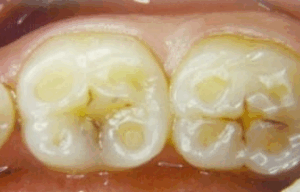
Damage to the enamel from acid wear is irreversible and permanent so prevention is key!
You should identify the root cause of your acid wear as the first step.
This will depend on the amount of damage done. Mild acid wear that is not getting worse can just be monitored with no treatment, however, moderate-severe cases may require full mouth rehabilitation in the forms of full coverage fillings or crowns. Best to talk to your dentist about your options.
Teeth which have acid wear are much more difficult to do fillings on because the quality of the enamel is poor. You are at a much higher risk of fillings not bonding and coming off/breaking.
“No offence, but I hate dentists.”
This is something I hear very often and it breaks my dental heart slightly but then it is usually followed up by:
“Don’t take it personally but I’m just so nervous”…
Then my achey-breaky dental heart feels a bit better! I never take it personally anymore because I see it as an opportunity to help someone get over their fear! That’s a powerful ability and makes me feel so fulfilled when I achieve it.
Most of the time people are so nervous when they come to see us. Sometimes because of a previous bad experience when they were younger, sometimes because they have no idea what is going to be done or what needs to be done. Other times, it is honestly just something they don’t know why but feel like they have to say!
So don’t worry, our team at Dental at Keys can look after you if you’re feeling nervous and explain all your options to you. We’ve had patients who are terrified to come in, who are now so comfortable and happy to come in!
We’ve also got a lovely trick to keep you relaxed, maybe some Mr Bean on the ceiling why you get your teeth done?*
Airway Obstruction in children is characterised by mouth breathing, snoring, tooth grinding, bedwetting, allergies or frequent ear or other ear/nose/throat infections. Breathing is primary and when obstruction is present, the body adapts muscle positions to create as much airway space as possible. If muscle positions are not normal, then bones grow abnormally.
**This blog post has been posted with permission from Dr. Derek Mahony.
Facial asymmetries and some TMJ dysfunctions (jaw joint problems) can also be attributed to orofacial muscle imbalances and deviate tongue postures due to airway interferences. The following is list of symptoms associated with airway obstruction in children:
85% of orofacial growth is accomplished by the age of twelve. Therefore, early identification of airway interferences, with diagnosis of the underlying cause, is essential to prevent orofacial growth abnormalities. If you, your dentist, dental hygienist or paediatrician observe any of the above symptoms and suspect possible airway obstruction in your child, evaluation by an ENT (ear, nose and throat) physician should be undertaken.
Did you know that the way your child breathes can affect the development of his or her jaws and facial structure influencing how the teeth fit together? Normal breathing should occur through the nose with the mouth closed. However, if the nasal passage is somehow obstructed, mouth breathing often results. Generally, nasal airway obstruction is caused by one or more of the following: (see figure 1)
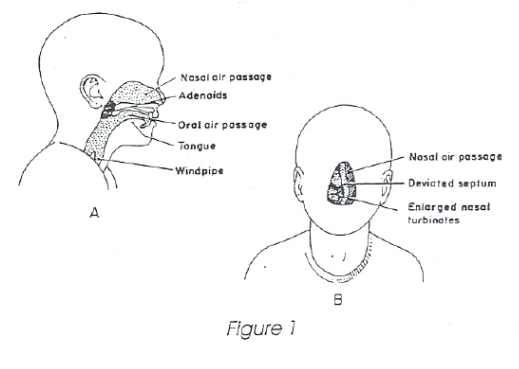
All of the above causes the child to breath with his or her mouth open. This open mouth posture causes the facial muscles to generate unnatural constrictive forces on the underlying bony structures (See Figure 2A). Narrowing and elongation of the upper jaw often is the result of such forces (see Figure 2B). In addition, the jaws tend to grow
apart, often causing front open bites which affect the position of the tongue and other facial structures. 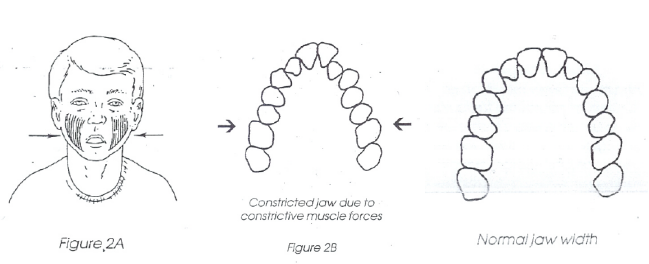
Also, because the lower jaw is dropped for mouth breathing, it tends not only to grow apart from the upper jaw, but also becomes positioned further back than normal, causing an overbite (Figure 2C).

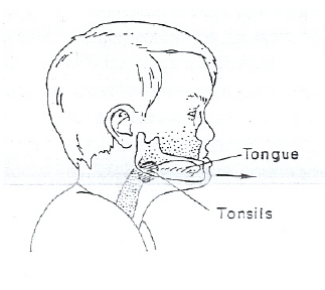
How the tongue rets in the mouth can also negatively affect facial growth. The tongue at rest should be high in the mouth which stimulates normal growth of the maxilla (upper jaw). Enlarged tonsils force the tongue in a downward and forward position which pushes on the lower jaw and the lower teeth (tongue trust). This in turn can contribute to prognathism (protruding of the lower jaw) by overstimulating jaw growth (Figure 3).
Please keep in mind that there are many other factors beside airway considerations that affect dental-facial development (ie. genetics, muscular tone, tooth and jaw sizes, allergies etc). There for addressing just these airway interferences will not always guarantee correction of dento-facial problems. However, if airway interferences are eliminated before facial growth is completed, a suitable environment will be establishes to promote a more normal development of the orofacial structures. This can eliminate or simplify the need for extensive orthodontic treatment. Also in cases where airway interferences have been eliminated, relapse of orthodontic treatment is greatly reduced. The results include not only a more stable dentition and bite, but also a more pleasing facial appearance for your child.
The following professional references have been provided for you and your medical practitioner if they would like to know more about the effects of airway obstruction upon facial growth.
It’s normal for children to snore when they are tired isn’t it? The answer to that is actually – NO! Too often we assume snoring to be the social norm for tired people (big and small) however research has shown that snoring may be more detrimental to our health then we know it. Whilst everyone knows what snoring is, it’s also important to know that heavy, audible breathing also falls under the same category as snoring and is just as bad!
Check out this video on Facebook by Today: https://www.facebook.com/iwakeupwithtoday/videos/1789804254387565/
Snoring, or heavy breathing whilst sleeping, is that deep annoying sound that one makes when their airway is blocked. Blocked airway? Yes! That’s right – snoring is due to you or your child not being to breathe properly when sleeping. The simple fact is that if you don’t breathe well when sleeping – you or your child may not be getting a proper night’s rest. We all know how important sleep is! It’s imperative for health and development and this is even more important in our children.
Children can suffer from numerous sleep conditions that severely affect their development. The problems caused by the sleep issues can manifest in permanent problems later on in adulthood that are very difficult/ impossible to correct. This is why problems are best diagnosed and treated when young.
We recommend booking in your children with us so that we can do a Dental & Airway assessment. From there, we may recommend a few options:
The first port of call is to consult a paediatric ENT specialist (ear, nose and throat specialist) or an Oral Myology clinic. ENT experts will check for obstructions in your child’s airway and ears whilst Oral Myology clinics will check your child’s breathing and muscles. Examination may include a scope (flexible camera through the nose), Imaging (e.g x-rays/CT scans), Physical examinations, and sleep studies.
Depending on what is wrong, treatment options include Surgery (best done when young so they recover well), muscle exercises, breathing exercises or medications such as Nasonex.
Even after treatment, the child usually has to relearn how to breathe properly through the nose. This is why it is better to treat early because a habit is easier to unlearn when you are younger.
Early orthodontics is basically doing orthodontic work while a child still has a mixture of primary (baby) and permanent teeth. This typically occurs between the ages of 7 to 12 although this can vary depending on the dental development stage of the child.
The advantage of early treatment is that the early diagnosis and treatment of your child may help an orthodontic problem earlier whilst often minimizing more serious orthodontic problems from occurring. By lessening these problems early, later orthodontic treatment may be shorter and easier (or not required in some cases).
Partial Braces are braces worn on the adult teeth, while your child still has primary teeth. These normally only involve the front 4 incisors and the first adult molar. This may or may not be used in conjunction with springs which help with some expansion. These are typically used to help resolve crowding in younger children.
Clear Aligners such as Invisalign First offer the same type of treatment that Partial braces do with the added benefit of removable Clear Aligners

Jaw expansion is typically done with maxillary expanders (more information here). These can either be removable or fixed. Maxillary expanders help to widen the upper jaw by pushing the teeth and bone outwards, and typically involve turning a super screw. Alternative expansion devices include the Invisalign Palatal Expander.
Mandibular advancement devices (functional appliances) include the MARA appliance, Herbst appliance, Twin-Block appliance or Clear Aligners (Angel Aligner A6 & the Invisalign Mandibular Advancement System). Again, these can be removable or fixed. These appliances help to position the lower jaw in a more forward position, thereby encouraging faster growth of the lower jaw into a more favourable position (eliminating an overjet).
Early treatment typically ranges from 6 to 18 months. This varies depending on the complexity of treatment.
Orthodontics is not just simply about straightening teeth. Here at Dental at Keys we aim to create a beautiful full smiles. We pay particular attention to the curvature, width and height of the smile. All of these aspects involve a lot more work than just straight teeth. The last thing we want for you is to have a flat straight smile (ie. Denture smile).
We also pay great attention to the profile of your face. Not only should your smile be full, but your facial profile should match it is as well. There is no point in extracting teeth in a patient who already has a sunken profile. Similarly, patients with lips that are too full should not have this worsen. This is why we say we treat the face, and not just the teeth.
An orthodontic functional appliance is either a removable plate or a fixed appliance that aims to correct the relationship between the upper and lower jaws. Often a patient will have their lower or upper jaws set too far forward or too far back. The aim of a functional appliance is ‘move’ the desired jaw back/forward into its correct position, thus ending with a more stable upper and lower jaw relationship. Occasionally we combine functional orthodontic therapy with orthopaedic expansion.
There are two main types of Functional Appliance categories – Fixed (glued-in) or removable.
Removable appliances include the classic Twin Block appliance and Clear Aligners (Angel Aligner A6 Mandibular Advancement Therapy).
*Please note that we do NOT offer Fixed Functional Therapy.
1) If a fixed appliance is made (eg. Herbst or Forsus appliance) – this is will glued to your back molars. It may be activate once every few weeks to push the jaw forward as required.
2) If the appliance is a removable plate – it is as simple as placing the appliance in your mouth and clicking it into place. Please note that this appliance needs to be worn all day and night (and during meals). It should only be removed for cleaning. Failure to wear the appliance during the require times will result in slower treatment.
Most functional appliances are designed to speed up the growth of the lower jaw. This is done by forcing the lower jaw to be positioned further forward into the proper relationship, allowing the jaw joint to grow and remodel into this new position. Severe cases may need the lower jaw to be position further forward slowly over a period of time. Once the correct relationship has been established, this position is held for a few months to allow the muscles to adapt to this new position (up to 6 months).
The appliance will be worn at all times for a period of approximately 6 – 12 months. This period may vary depending on your tailored treatment plan, and progression of treatment
once the functional appliance has been fitted. The appliance only works when it is worn, and if removed – treatment progress may be lost. Wearing a removable appliance whilst eating results in the movement of your jaw up to 13x faster!
After treatment with a functional appliance, it is very likely that you will need to have further treatment such as braces to straighten your teeth. Treatment such as braces may also commence whilst you are still wearing your functional appliance. Each case is different, and your dentist will inform you of your tailored treatment plan.
Orthodontics is not just simply about straightening teeth. Here at Dental at Keys we aim to create a beautiful full smiles. We pay particular attention to the curvature, width and height of the smile. All of these aspects involve a lot more work than just straight teeth. The last thing we want for you is to have a flat straight smile (ie. Denture smile).
We also pay great attention to the profile of your face. Not only should your smile be full, but your facial profile should match it is as well. There is no point in extracting teeth in a patient who already has a sunken profile. Similarly, patients with lips that are too full should not have this worsen. This is why we say we treat the face, and not just the teeth.
Wondering what the team at Dental at Keys was up to yesterday? 🤔
It was an amazing day where our entire team came together for a powerful training session focused on enhancing our communication skills! 🗣️✨ We’re committed to making every visit a comfortable and positive experience, and what better way than by learning new techniques to connect and care for our patients even better? 💫👥
From role-playing activities to communication exercises, we covered it all! 🌟 Our goal is to make sure every patient feels welcomed, heard, and well taken care of. 💖 This training is just one of the many ways we strive to provide top-quality care!
Here’s to continued growth, improved patient experience, and even brighter smiles! 😁
#DentalAtKeys #TrainingDay #PatientCare #BetterTogether #SmileWithConfidence #CommunicationMatters #TeamTraining #PatientFirst #QualityCare #BuildingTrust #HealthcareHeroes #AlwaysLearning #DentalCommunity
Taking your child to the dentist can be a bit stressful—for both parents and kids. However, with the right approach, you can make your child’s dental visits a positive experience and set the foundation for a lifetime of good oral health. To help you out, here are our top five tips for taking kids to the dentist:
Timing is everything, especially when it comes to kids. Choose a time of day when your child is most comfortable, well-rested, and cooperative. If your child is happiest and most alert in the morning, that’s the best time to schedule their appointment. If they’re tired or sleepy, they might be grumpy or uncooperative, making the experience more challenging for everyone. A well-timed appointment sets the tone for a positive visit!
It might be tempting to promise a reward or treat to encourage your child to visit the dentist, but this can send the wrong message. Offering a reward might make them think that going to the dentist is something difficult or scary that requires a bribe to endure. Instead, keep the focus on how visiting the dentist is a normal part of staying healthy. Reinforcing that dental check-ups are a routine activity helps children view the experience more positively, without attaching fear or anxiety to it.
It’s completely normal for kids to feel nervous or shy during their first dental visit. They may even cry, but that’s okay! The first appointment is mostly about familiarizing them with the environment, the dentist, and the equipment. The bright lights, whirring sounds, and different smells are all new, so it’s natural for them to feel unsure. By the end of the visit, many children are already more comfortable, and by the second visit, they’re often running into the chair with excitement. Patience and positivity go a long way in helping your child feel at ease.
Before their appointment, prepare your child by talking to them about the dentist in a simple and positive way. Avoid going into too much detail to prevent unnecessary worry. There are excellent children’s books featuring popular characters like Peppa Pig or Dora the Explorer that show what a dentist visit is like, making it seem fun and non-threatening. These stories help familiarize children with the idea of visiting the dentist in a way that’s relatable and engaging. Just remember to keep the conversation light and upbeat to avoid sparking any anxiety.
When it comes to explaining dental procedures or treatments, leave it to the experts! Dentists who specialize in treating children know exactly how to explain things in a way that won’t frighten or overwhelm them. For instance, instead of saying “injection,” which may instantly trigger fear, we use playful terms like “sleepy juice” to make it sound less intimidating. This approach not only keeps the child calm but also builds trust between the dentist and the child. Sometimes, this technique works for adults too! 😄
Taking your child to the dentist doesn’t have to be a stressful experience. By scheduling their appointment at the right time, keeping conversations positive, and allowing the dentist to guide them through the process, you can help your child feel more comfortable and even excited about going to the dentist. With time, regular visits will become a natural part of their routine, helping to build a strong foundation for lifelong oral health.
A little patience, preparation, and positivity can make all the difference!
Book with your local Family Dentist here in Keysborough now!
#KidsDentalCare #HealthySmiles #FirstDentalVisit #PositiveParenting #HappyTeeth #DentalHealthForKids
📢 Important Announcement! 📢
Our dental clinic will be closed for staff training on Friday, October 25th, 2024. 🏫✨ This is an important opportunity for our team to enhance their skills and knowledge to serve you better!
We appreciate your understanding and encourage you to book your appointments around this date.
Thank you for your support! 💙
#StaffTraining #DentalClinic #ContinuousImprovement #PatientCare
